
I was reading the most interesting article over the weekend by Ryan Moulton about colours which can’t be shown on screen (it also clarified a thing about dinosaurs that I had never quite understood). Humans have three different kinds of cone cells for seeing color and they’re pretty basic compared to birds (and most likely dinosaurs too) which have four, one of which can see ultraviolet light. There is a lot going on in the world which humans simply don’t see.
If a token is burned in the woods and nobody is there to write about its productivity impact, does it count?
I feel AI is rapidly going to require some kind of fourth cone equivalent to capture what is (or isn’t) happening beneath the fairly simplistic measure of tokens burned. Dylan Patel and crew call this unmeasured productivity AI Dark Output although I think ‘Suspected Productivity Increase’ would have been much funnier. Cumulative investment in AI consulting has gone from under $2b to ~$7b (including OpenAI’s DeployCo and Anthropic’s vehicle) and Chamath Palihapitiya has just raised $130m for his 8090 consulting firm.
There may be a lot of economist eye-rolling at that paragraph but it at least highlights the limitations of GDP’s more industrial-oriented measurement across economies which have gone from ~50% services employment to ~80% (e.g. the US) over the last fifty years. On top of measuring the wrong things, we are also getting worse at measuring economic data more generally.
Measurement aside, building continues. A little while back I wrote about the trade-offs involved in creating the intelligence sector:
You can have an abundance of intelligence but you might have to trade an abundance of device choices in order to access it. The war effort of the 1940s becomes the token effort of the 2030s?
Joe Weisthenthal made the same point more eloquently on X the other day:
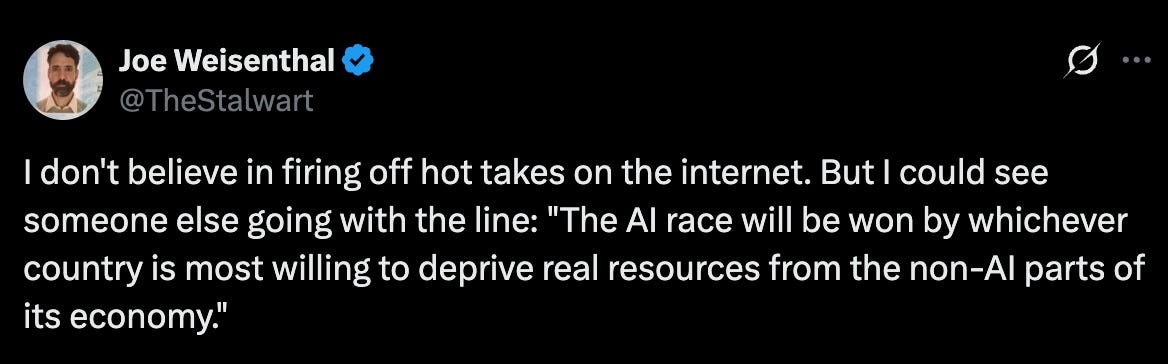
How soon until we’re tracking a very specific basket of AI-related inflation? Phone prices will not be the last thing to jump because of component shortages.
Other reading/mulling
I was at a highly enjoyable dinner with Jon Weber who shared some superb advice on building good boards. Here are a few good questions to ask potential board members. Oh and worth reminding people (especially founders) of this great guide for startup boards that Starboard produced.
Ben Barbersmith is posting on X about Levellr’s journey to rebuild social listening for all the new places (Discord, Reddit etc.). AI-fuelled inflection oozes from every post.
AI Enablement Insider is building the first pricing benchmark for AI consulting. This will be helpful for a lot of this readership. More here if you want to get involved.
Sahil Patwa (an investor in AI roll-ups) published a useful AI roll-up financial model
Bending Spoons, a neo-PE firm which I’ve mentioned in a few places, went public at a fairly astonishing valuation.