
Gaming is a sector which tends to surprise a lot of investors who haven’t been exposed to it before. And frankly it took me many years and multiple companies to be capable of explaining some of its peculiarities.
One of its oddities is that, for a content type driven by new platforms, the industry tends to be pretty entrenched in the last platform of scale. This goes all the way back: the arcade industry never believed that home consoles would work. Console gaming didn’t believe that social and mobile gaming were what people wanted. And basically nobody believed that user-generated-content (UGC) platforms like Roblox and UEFN/Fortnite would work.
This behavior goes hand in hand with one of the life-long lessons I’ve learned is that every new generation redefines quality for themselves (regardless of what older generations think). In gaming that definition of quality has moved from high resolution to convenience to free-to-play to social. UGC platforms like Roblox and Fortnite had already established that the next generation of content consumers don’t care about your consoles, don’t need to be labelled as gamers and will just hang out in brainrot games. AI is about to take this natural generational break and do something radical to it.
Just watching X over the last few days, it feels like AI has taken gaming from default dead in the eyes of investors to one of the most exciting vectors on the planet:
Easy (ish) game decompiling is basically allowing me to remix games. I’m finally at the point where I can take my favourite games of all time and just make them Batman versions. Wild
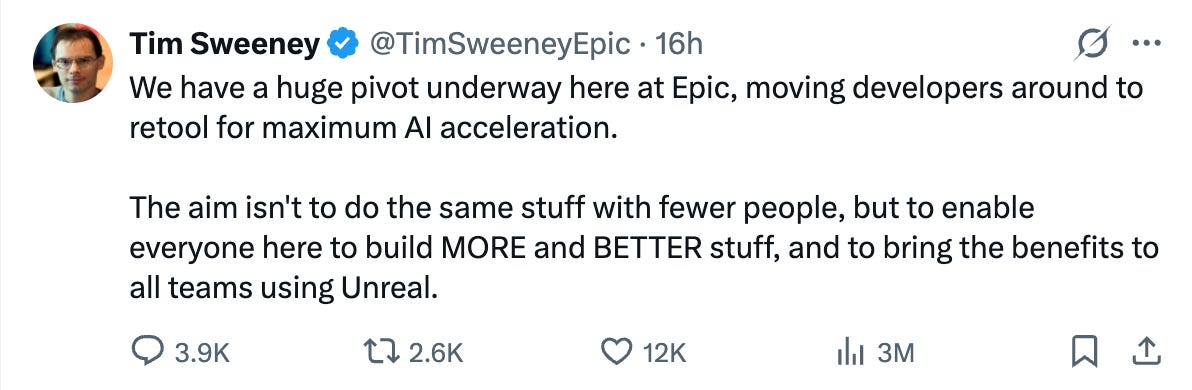
Throwing frontier models at Fortnite and Roblox game engines is letting creators release games into these platforms faster than ever
Initiatives like Playground and Unity Spark from Google and Unity are replicating this: prompt for a playable game, distributed across Google’s consumer surfaces
This is disruption on an enormous scale.
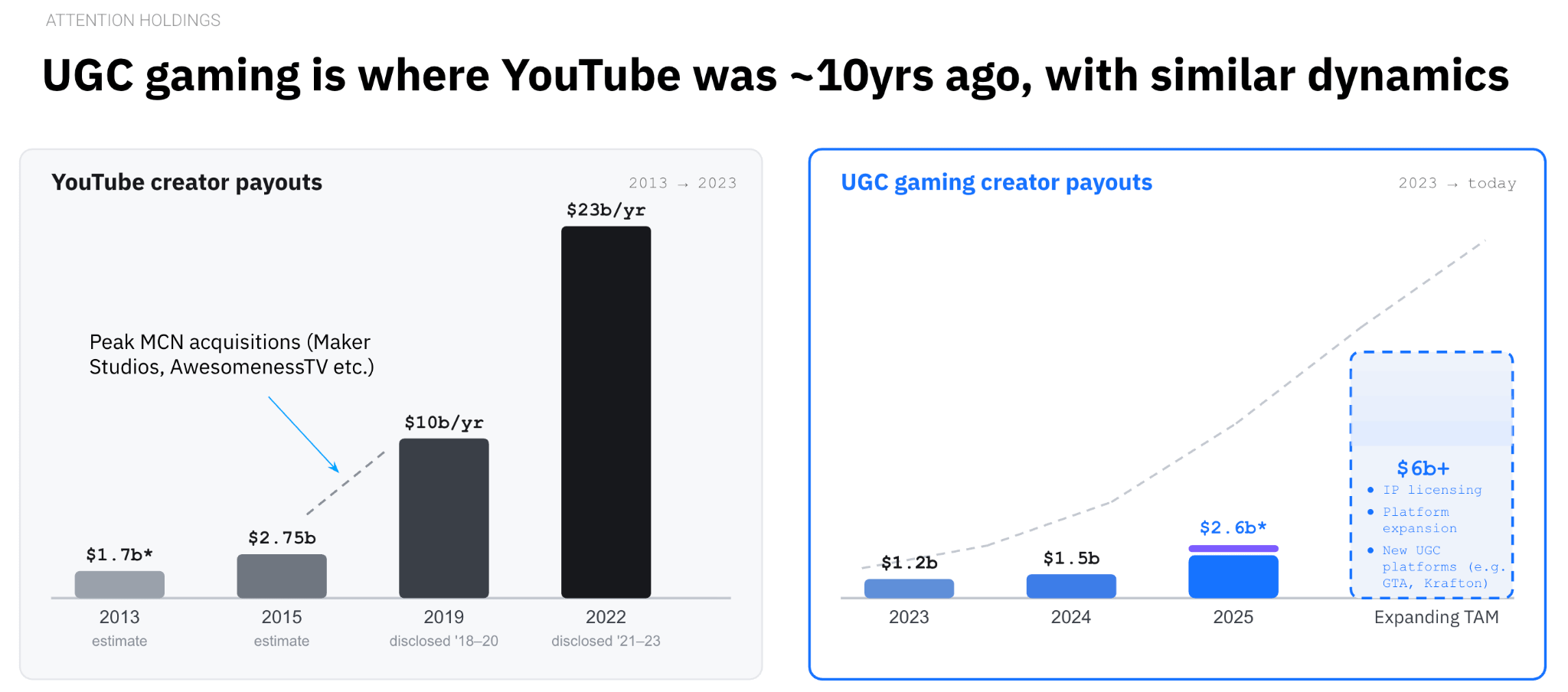
But I think this is the moment that game developers become game creators. Which historically makes sense. Most people don’t realise that Roblox is actually the same age as YouTube. Although they’ve had different pacing, this sequence of growth is starting to look very similar. YouTube was ignited by kids (who had time) and iPhones (which removed barriers to video uploading). Roblox (and UGC in general, including Fortnite) is about to hit its YouTube moment. It’s already being driven by kids and AI is about to create the iPhone effect.
Who are the winners from all of this?
The UGC platforms with scale
Patrick Collison wrote a great post about how personal agents might make distribution irrelevant. I don’t think that happens for a long time. For now and the foreseeable (whatever that is) future, existing games aggregator platforms are almost all undervalued for two reasons. One is obvious, even with the ability to create any game possible, monetizing requires putting it in front of people. Secondly, exponential rates of content creation (and attention competition) means it is becoming ever-harder (and close to impossible) to break through that level of noise and create something of the scale of a Roblox or Fortnite.
The gaming MCNs
A large section of X is now dedicated to AI catastrophism but (at least for history readers) this remains the least interesting outcome. AI was always going to lower the barrier to digital entrepreneurship. Gaming is no exception. The long tail will stretch to infinity, mostly with personalised games built for people’s individual taste. The occasional break-out will be huge but the net effect is an expansion from thousands of creators to millions. MCNs are woefully maligned from the YouTube era but they were a critical piece in scaling creators into businesses and sometimes into empires. Creator services are going to become one of the most valuable leverage opportunities outside of platforms.
The community intelligence layer
With infinite places to invest your attention, it’s going to be harder for brands, creators and publishers to capture signal. I’m certain we’ll end up seeing some kind of ‘community intelligence layer’ emerge as a generational replacement to social listening as part of all of this change.
And certainly more I haven’t thought of. What an incredible time to be alive.