
This was going to be a post about a whole other thing and then I saw this on X yesterday.
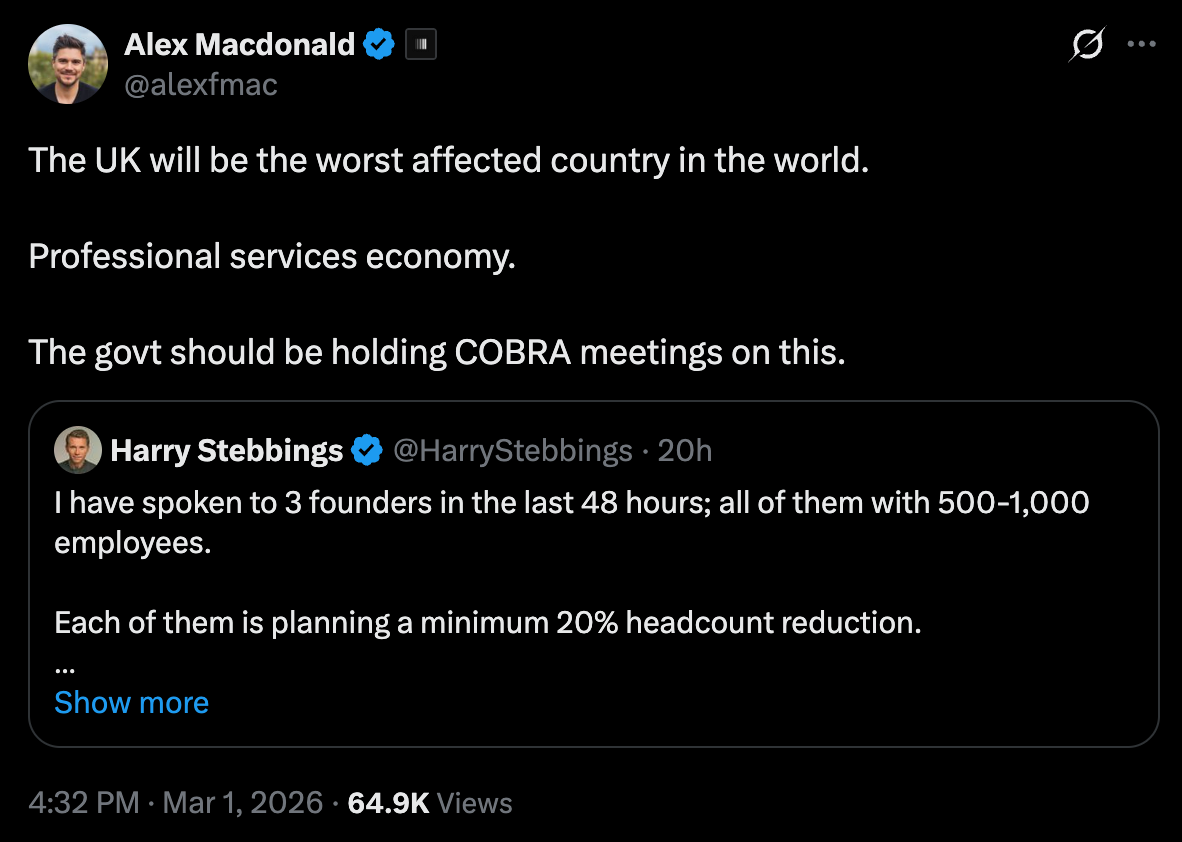
I posted a longish (at least for X) reply which I thought I’d expand on a bit here because I really worry that many serious people are getting confused by what is and isn’t happening.
Firstly for context, and especially for anyone who is new around here, we recently set up a holding company called 10xHumans which invests into AI professional services (and media). So I’ve spent time with ~100 founders of native AI consulting firms over the last 6 months across the US, UK and Europe. You’ve probably read (and been annoyed by) their posts on LinkedIn which make you feel inferior in your AI usage. However these folks are also the ones at the coalface of AI adoption in enterprise i.e. how it’s actually going.
Very simplistically, there are two stories here: one is the software/tech sector and one is basically everything else. For context, software/tech contributes about 5% to global GDP. Outside of software (which I’ll come back to in a bit), some observations from AI consultants we’ve spoken to:
In some cases ‘because AI’ is the cover for a bunch of layoffs which needed to happen because of strategic missteps. There is still a surprising amount of Covid decisions still lingering in companies. There are plenty of lower profile examples than Block’s recent AI-washing if you go looking.
Sustained enterprise AI adoption is much slower outside of software/tech than software/tech people realise. This is quite often down to mundane factors like a lack of bandwidth or general human factors (resistance to change, cold start, budget, etc).
It’s very common for AI projects in mid-market/SMB to have a cost-split of 10% licenses/tokens, 90% organizational readiness/change management.
The average paradigm for SMB/mid-market AI adoption remains some version of ‘I’m just waiting for a Google/Microsoft solution’.
Back to software/tech. There will definitely be job destruction/creation but overall the (early) data seems to show increased productivity (and anecdotally lower barrier to entrepreneurship). However outside of this sector, it is probably a cycle that plays out over 10yrs not 2yrs for some of the above reasons. I’ve had several conversations with consultants working on AI projects who feel that 15yrs might be a more realistic timelines for industry transformation. Either way I am not an AI bear and I don’t state these opinions with any kind of glee-I think a 1000x bigger risk than mass layoffs from AI is not enough investment going into *helping people/companies use AI meaningfully*. We need to massively accelerate AI Enablement in non-tech sectors to increase economic performance (especially in Europe where productivity is lagging).
To state the numbers, investors have put ~$800B into AI infra (models, data centres, GPU i.e. the capability) but less than ~$2B into AI Enablement (training, consulting i.e. the stuff which produces the economic gains).
Both governments and investors should be far less concerned about AI-related layoffs and far more concerned about the consequences of this imbalance. That’s worth a COBRA meeting or two.
“If you wish to make an apple pie from scratch, you must first invent the universe.”
Actually this is quite a good observation from the latest AI Enablement Insider post: "Projects frequently end up with the CEO even in organizations with 500 or more employees. Not because the CEO is the natural buyer, but because no one else has authority. Budget lines rarely exist at the start of the year, and creating one mid-cycle is political work." https://www.aienablementinsider.com/p/how-to-save-your-deals-when-buyers-get-lost-in-the-buying-process